

In class today, we discussed Whitman’s controversial perspective on enlightenment, the divine, and humans’ relationship with nature. His sexual descriptions of the union of the body, soul, and nature and portrayal of embodied epiphanies promote the embracement of bodily pleasures, which opposes traditional theological beliefs of the body as a vessel for the soul. Many religions promote the idea that the resistance of the sinful, bodily desires, such as sex and gluttony, in an effort to fortify the pure soul. In contrast, Whitman equates the body and the soul. Through his sensual descriptions of epiphanies in nature, he shows that people do not need to suppress their bodily urges in order to achieve enlightenment.
Our discussion of sexual suppression and desire made me think of section 11, which describes a lonely woman who watches 28 bathing, young men from behind the blinds of her window. Ever since we read this poem for the first time, I’ve kept thinking about this section. I would think that his sensual descriptions of the woman’s sexual desires were controversial and considered inappropriate.
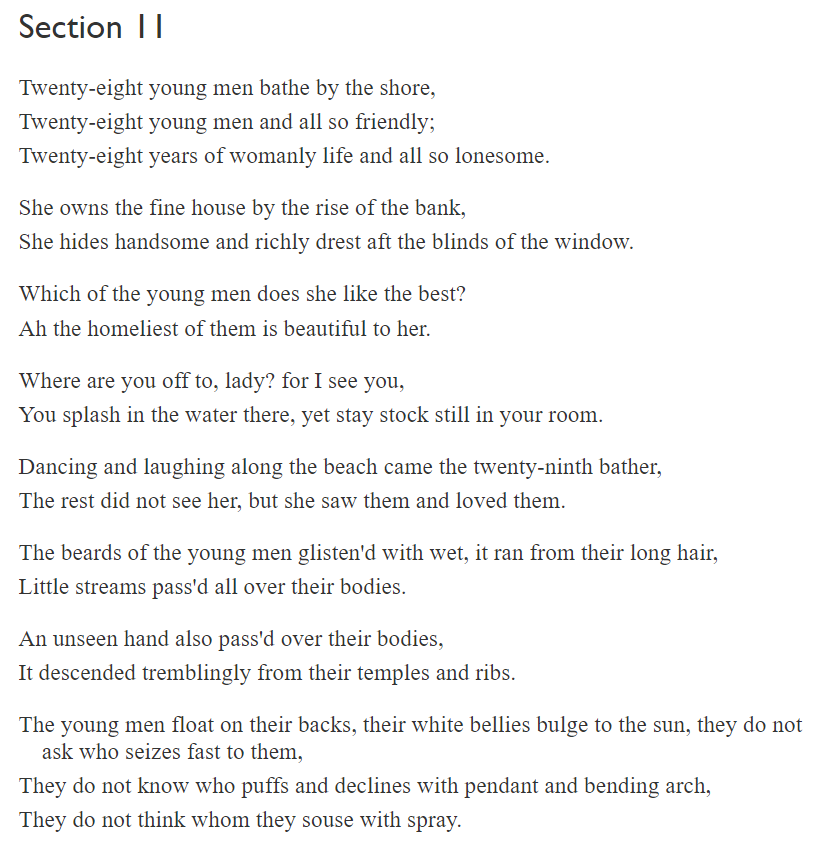
- How does Whitman capture the woman’s sexual desires? How does he portray sexual resistance?
- Is Whitman making a political statement about gender in this section? Does it relate/support his vision of democracy?
- Why 28? I wonder if this number is significant…
- What is the meaning of the “unseen hand”?
- Why does Whitman include this section? How does it relate to Whitman’s beliefs about the body and embodied epiphanies? How does it relate to the poem’s overall purpose?
Answer a question(s) or share any thoughts you have about this section! I would love to hear what you all thought of it.
It took me a minute to develop any thoughts about section eleven other than it was a bold move to include female sexual desire in any kind of work at this point in history. Bravo, Walt, for pointing out that women have sexual desires. But I think Whitman picks 28 as the number to represent “Twenty-eight years of womanly life and all so lonesome.” Meaning, that the onlooker is beyond marrying years and should be dried up and set to the side. Hey, I don’t personally believe that, but it was the prevalent societal belief in the 19th century.
Whitman’s twenty-eight year old is a peeping tom filled with desire, “She hides handsome and richly drest aft the blinds of the window.” She is a spinster (or perhaps a widow since she does own a house), taking a gander at the fellows taking a dip, something that she shouldn’t even be interested in doing.
The speaker sees the woman’s desire (soul?) leave her body and watches her go down to the water “Dancing and laughing along the beach…” her desire becomes the twenty-ninth bather. The twenty-eight year old is the owner of the “unseen hand” that “pass’d over their bodies,” She’s having quite the epiphany, having transcended the confines of her body with her mind and yet experiencing the pleasure with her body.
I love your close reading and completely agree with every point you make! I think it’s great that Walt decided to include a female character and acknowledge her sexual desires. I especially love the line: “Where are you off to, lady? for I see you”. Here he kind of points to every woman, saying, “I know you have been told it is shameful to have sexual desires, have been made to feel as if you have to hide that part of you. But it is okay. I see you and I understand how you feel.”
I agree that this is a fascinating section, especially because Whitman uses a woman to convey ideas of sexual desire, which I would think, given the time, would have been even more controversial than if Whitman had used a male character for this section. Regardless, I think the number 28 has to do with the last line of the first stanza: “Twenty-eight years of womanly life and all so lonesome.” I assume this means that the woman is 28 years old and each of the 28 men represent one year of her life (Amanda touches on this in her response). The 29th man who comes along represents the future, how the woman will feel about her sexual desires and her understanding of her body after this encounter with the men. I think the 28 years and the 28 men signify longevity. The desire to feel connected to someone else and even the desire for intimacy doesn’t necessarily ease over time. Perhaps, these feelings only intensify with age, making them even more difficult to suppress. Whitman might simply be saying enough is enough. Women and men alike can seek pleasure and act upon desire, and, according to Whitman, there is nothing wrong with that (but perhaps there is something most unfortunate about 28 lonely years of living).
Pingback:good shop dumps
Pingback:สล็อตวอเลท ไม่มีขั้นต่ำ
Pingback:Bob Biswas
Pingback:colourcee.bet
Pingback:remington 870 wingmaster
Pingback:บาคาร่าเว็บตรง
Pingback:floresta
Pingback:Buy Anaconda 6" Stainless .44 mag Online
Pingback:เงินด่วนมีนบุรี
Pingback:Investment opportunities
Pingback:Plus d'information
Pingback:fritter mintz 31 259 12% 3
Pingback:liberty cap mushrooms in ohio
Pingback:Buy Crystal Meth Online For Sale Melbourne
Pingback:เล่นบาคาร่า
Pingback:สล็อตวอเลท ไม่มีขั้นต่ำ
Pingback:ป้ายโฆษณา
Pingback:pgslot
Pingback:betwinner cl
Pingback:führerschein kaufen online
Pingback:steenslagfolie
Pingback:15 daagse rondreis senegal gambia
Pingback:https://dongythaytoan.org
Pingback:ufazeed
Pingback:ประวัติคาสิโน big gaming
Pingback:ส่งพัสดุ
Pingback:สล็อตออนไลน์ คืออะไร ?
Pingback:https://stealthex.io
Pingback:sportbet4x
Pingback:faw99
Pingback:private my free cams no tokens required
Pingback:เน็ต AIS
Pingback:ป้ายแท็กเสื้อผ้า
Pingback:เว็บหวย 1000
Pingback:ufabet789
Pingback:joker369
Pingback:betflix wallet
Pingback:เว็บปั้มไลค์
Pingback:lg96
Pingback:pgslot168
Pingback:웹툰 사이트
Pingback:ผู้ผลิต โบลเวอร์
Pingback:เติมเกม
Pingback:สล็อตออนไลน์เกาหลี
Pingback:Werewolf\'s Hunt
Pingback:เว็บปั้มไลค์
Pingback:fruit cocktail casino